
Waste segregation is a major challenge in maintaining environmental cleanliness and enabling effective recycling. Manual segregation methods are time-consuming, unhygienic, and often inefficient, leading to improper waste disposal and increased environmental pollution.
The Next-Gen Waste Separation Robot provides an intelligent and automated solution to this problem. This system uses a combination of sensors and a microcontroller to identify and classify waste materials based on their physical and material properties, such as metal, dry waste, and wet waste.
Once the waste is detected and classified, the robot either moves autonomously or uses a robotic arm mechanism to place the waste into designated bins. This reduces human intervention and ensures accurate segregation.
Key Features :
Automatic waste identification
Separation into multiple categories
Reduces human contact with waste
Environment-friendly and scalable design
( This project demonstrates the practical application of robotics and sensor technology in smart cities and waste management systems. )
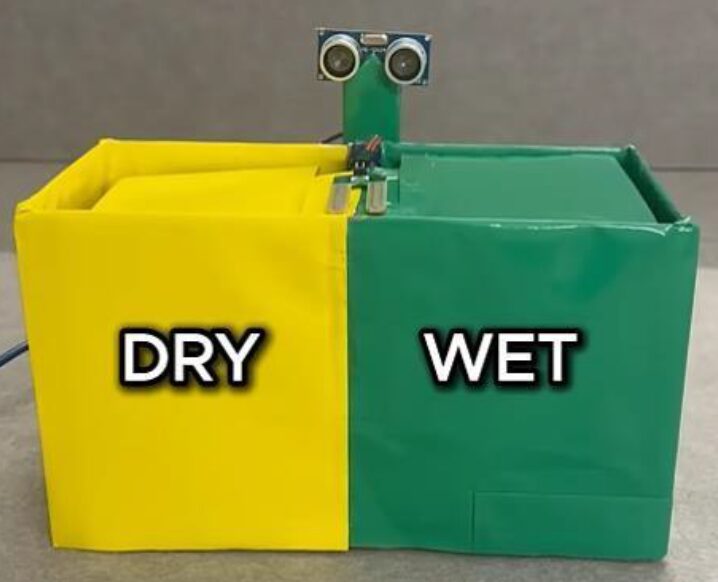
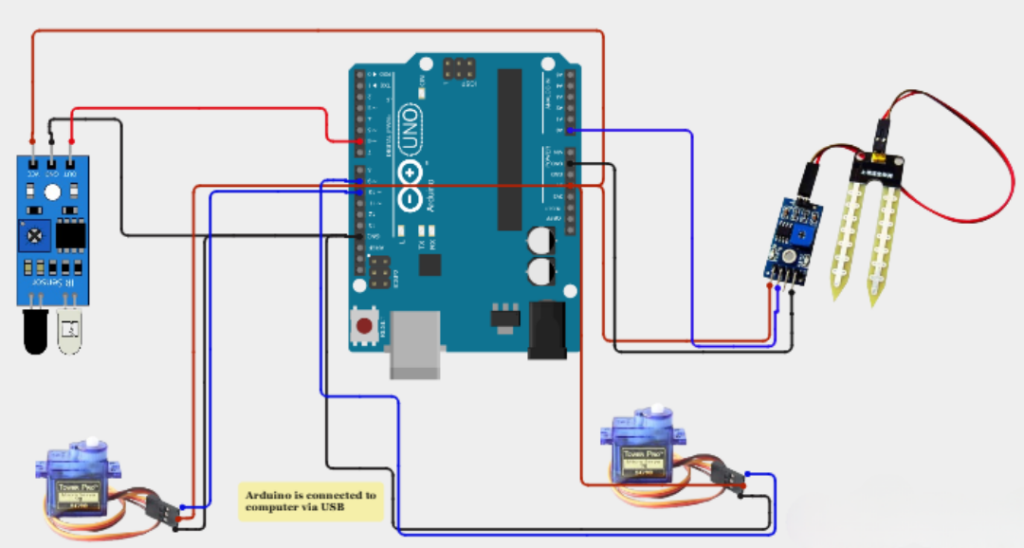
CIRCUIT DIAGRAM
Connection Description (Wiring Map)
Main Components :
- Microcontroller: Arduino Uno / Mega
- IR Sensor: Detects object presence
- Moisture Sensor: Identifies wet waste
- Servo Motors: Controls waste-diverting mechanism
- Conveyor : Moves waste
- Power Supply: 5V and 12V regulated supply
Wiring Summary :
Component | Arduino Pin | Description |
IR Sensor | D2 | Object detection |
Moisture Sensor | A0 | Wet waste detection |
Servo Motor 1 | D9 | Bin selector |
Servo Motor 2 | D10 | Conveyor / gate control |
Power Supply | Vin / GND | System power |
Working Principle :
- Waste is placed on the conveyor or input area.
- IR sensor detects the presence of waste.
- If not metal, moisture sensor checks wet or dry condition.
- Based on detection:
Wet waste → Wet bin
Dry waste → Dry bin
- Servo motors rotate the diverter or robotic arm to drop waste into the correct bin.
Testing the Hardware :
IR Sensor Test
Place an object to verify detection.
Moisture Sensor Test
Touch wet and dry materials to observe readings.
Servo Motor Test
Check angle movement for bin selection.
Full System Test
Place different waste items and verify correct segregation.
Applications :
Smart waste management systems
Recycling plants
Public dustbins
Educational robotics projects
Smart city initiatives
Troubleshooting :
Problem | Possible Cause | Solution |
Waste not detected | IR sensor misalignment | Adjust sensor position |
Wrong waste classification | Sensor threshold issue | Calibrate sensors |
Servo not rotating | Power issue | Use external power |
Conveyor not moving | Motor driver fault | Check wiring |
System resets | Voltage drop | Separate motor power |
( The Waste Separation Robot is an automated robotic system designed to identify and sort different types of waste, such as dry waste and wet waste, using intelligent sensing and classification techniques. This system plays a key role in modern waste management by reducing manual labor and improving the efficiency of waste segregation.
The robot typically uses a combination of sensors—such as moisture sensors to distinguish wet waste, infrared sensors for object detection, and sometimes cameras for image-based classification. Advanced versions may incorporate computer vision libraries like OpenCV along with machine learning models to improve accuracy in identifying different waste categories.
A microcontroller or microcomputer (such as Arduino, ESP32, or Raspberry Pi) processes the sensor data and controls the robotic mechanism. Based on the detected type of waste, actuators like servo motors or conveyor systems are used to direct the waste into the appropriate bin. For example, wet waste can be diverted into biodegradable bins, while dry waste such as plastic or paper is sent to recycling bins.
The system can also include additional features such as LCD/OLED displays for status updates, buzzer alerts, and IoT connectivity for remote monitoring and data logging. With IoT integration, waste collection data can be tracked in real time, helping municipalities and organizations optimize waste management processes.
This project is highly useful in public places, smart cities, recycling centers, and households. It promotes cleanliness, reduces environmental pollution, and supports efficient recycling practices. With further enhancements, the robot can be trained to classify more categories like metal, glass, and e-waste, making it a more advanced and scalable solution for sustainable waste management. )