
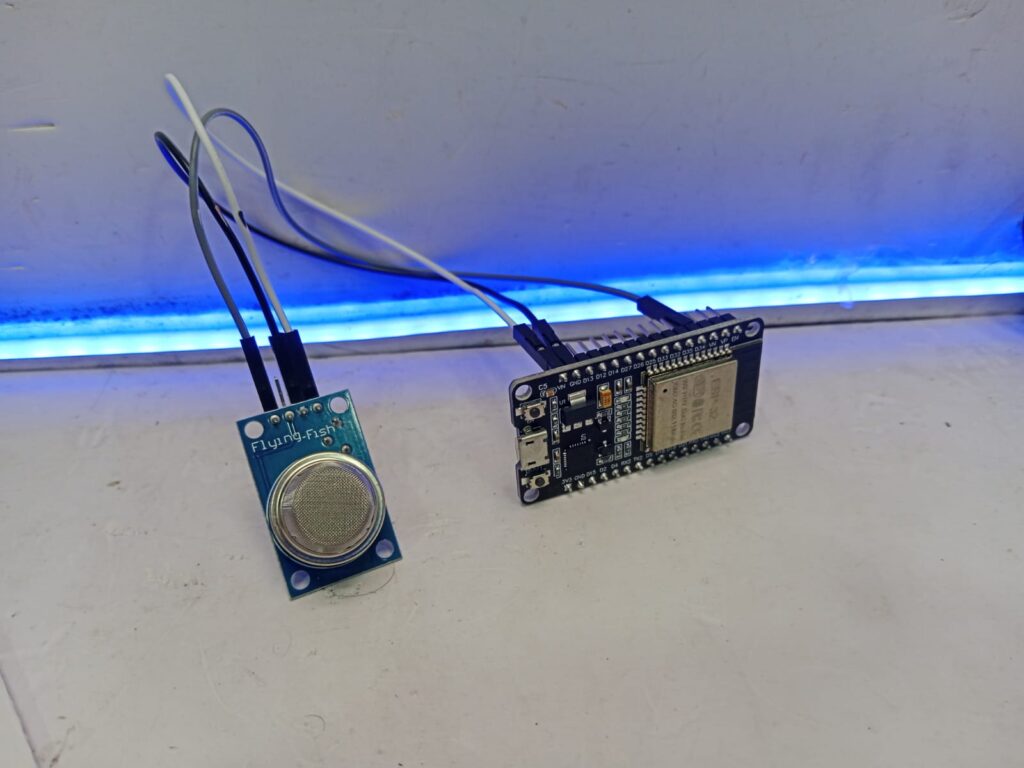
LPG (Liquefied Petroleum Gas) is widely used for cooking and heating in homes and industries. It mainly consists of propane and butane, which are highly combustible gases. Leakage can occur due to faulty regulators, damaged pipes, or loose connections, posing serious safety risks.
As an Effortless Robotic Project For Beginners, the LPG Gas Leak Detector provides a simple yet effective safety solution. This system continuously monitors the surrounding air for the presence of gas using sensors such as the MQ-2 or MQ-6.
When the gas concentration exceeds a safe threshold, the system immediately alerts users through a buzzer, LED indicator, or even a display module. Advanced versions can also trigger exhaust fans or send notifications for enhanced safety.
Objectives :
- Detect LPG leakage quickly
- Provide early warning through an alarm
- Prevent fire accidents
- Improve home and industrial safety
Main Components :
1. Gas Sensor
MQ-6 Gas Sensor (best for LPG detection)
Detects propane and butane gases
Analog and digital output
2. Microcontroller
Arduino Uno / ESP32
3. Output Devices
Buzzer (Alarm)
LED Indicator
LCD Display (optional)
GSM Module (optional for SMS alert)
4. Power Supply
5V DC supply
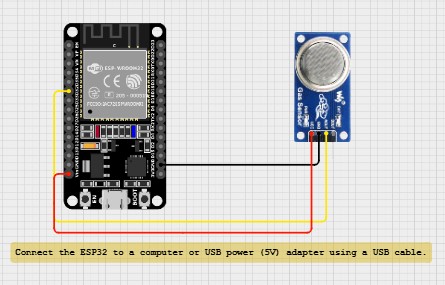
CIRCUIT DIAGRAM
Applications :
- Home kitchens
- Restaurants
- LPG storage units
- Gas pipelines
- Industrial plants
- Laboratories
Connection Description (Wiring Map – ESP32 Version) :
Component | Arduino Pin | Description |
MQ-6 VCC | 5V | Power supply |
MQ-6 GND | GND | Ground |
MQ-6 A0 | A0 | Analog output |
Buzzer | D8 | Alarm output |
LED | D9 | Visual indicator |
GSM TX | D2 | Serial communication |
GSM RX | D3 | Serial communication |
Common Ground | GND | Shared ground |
Working Principle :
- Gas Detection
- MQ-6 sensor detects LPG concentration in the air.
- Sensor resistance changes with gas concentration.
- Signal Processing
- Analog value sent to Arduino.
- Microcontroller compares the value with the threshold.
- Alert Activation
- If gas level exceeds safe limit:
- Buzzer turns ON
- LED glows
- SMS alert sent (optional)
- If gas level exceeds safe limit:
- Continuous Monitoring
- System keeps monitoring the gas level in real time.
Testing the Hardware :
Step 1: Sensor Calibration
Power the MQ-6 sensor for 2–5 minutes to stabilize.
Step 2: Gas Exposure Test
Carefully release small LPG near the sensor.
Observe an increase in sensor reading.
Step 3: Alarm Test
Confirm buzzer and LED activate above threshold.
Step 4: GSM Test (Optional)
Verify SMS is received when gas is detected.
Applications :
Home kitchens
Restaurants
LPG storage units
Gas pipelines
Industrial plants
Laboratories
Troubleshooting :
Problem | Possible Cause | Solution |
No sensor output | Wrong wiring | Check connections |
False alarms | Low threshold | Adjust sensitivity |
Buzzer not working | Pin error | Verify output pin |
No SMS | GSM network issue | Check the SIM card |
Sensor unstable | Not warmed up | Wait for calibration |
( The LPG Gas Leak Detector is a crucial safety system designed to detect leakage of Liquefied Petroleum Gas in homes, laboratories, and industrial environments. LPG, which mainly consists of propane and butane, is highly flammable and poses serious risks such as fire hazards and explosions if leaks go undetected.
The system typically uses gas sensors such as the MQ-6 Gas Sensor to continuously monitor the concentration of LPG in the surrounding air. When the gas level exceeds a predefined safety threshold, the sensor sends signals to a microcontroller (such as Arduino or ESP32), which processes the data and activates alert mechanisms.
These alert systems can include a loud buzzer, LED indicators, and even advanced notifications like SMS alerts using GSM modules or mobile notifications through IoT platforms. Some versions may also automatically trigger exhaust fans or shut-off valves to reduce the risk of gas accumulation.
This project is based on the principle of gas sensing and environmental monitoring, ensuring real-time detection and rapid response to hazardous conditions. It provides a reliable and cost-effective solution for preventing accidents and enhancing safety.
The LPG Gas Leak Detector is widely used in kitchens, gas storage areas, restaurants, laboratories, and industries where gas leakage can be dangerous. It significantly reduces the chances of fire accidents and protects both life and property.
With further enhancements, the system can be integrated with smart home automation, cloud monitoring, and AI-based predictive safety systems for even more advanced protection. )