
In homes, offices, and classrooms, temperature control is typically handled manually, which can lead to energy wastage and inconvenience. Devices like fans and air conditioners are often left running unnecessarily or not adjusted according to changing environmental conditions.
As part of Advanced Smart Home Robotic Projects, the Temperature-Based Automatic Fan/AC Control System offers an intelligent and energy-efficient solution. This system automatically decides whether to operate a fan or an air conditioner based on real-time temperature readings.
The project uses:
Temperature Sensor to measure the ambient temperature
Microcontroller to process and analyze temperature data
Relay Module to automatically switch the fan or AC ON/OFF
When the temperature crosses predefined thresholds, the system activates the appropriate device—ensuring comfort while minimizing energy consumption.
Key Features :
Automatically turns ON fan at a moderate temperature
Automatically switches to AC at higher temperatures
Prevents both the fan andthe AC from running simultaneously
Reduces power consumption and improves comfort
( This system demonstrates the application of embedded systems in smart home automation. )
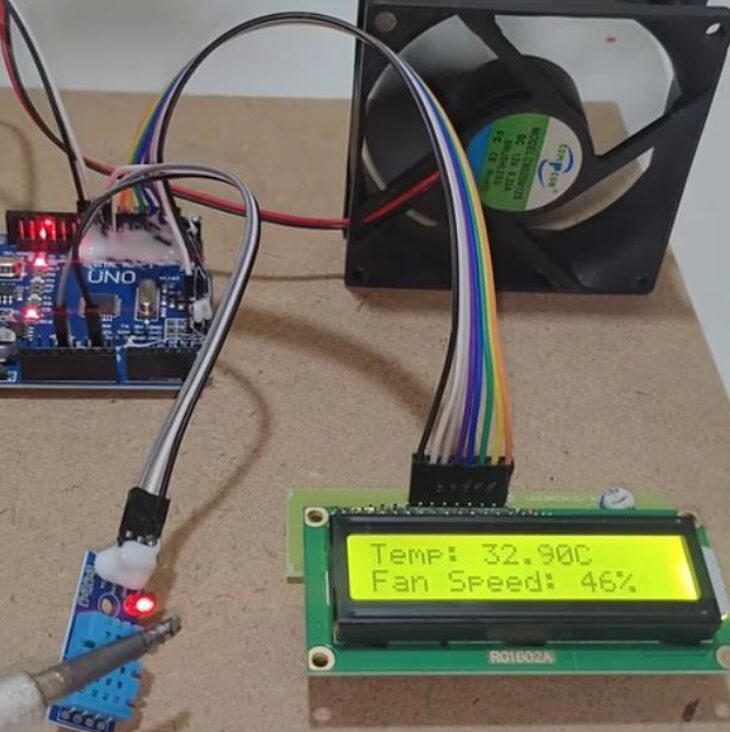
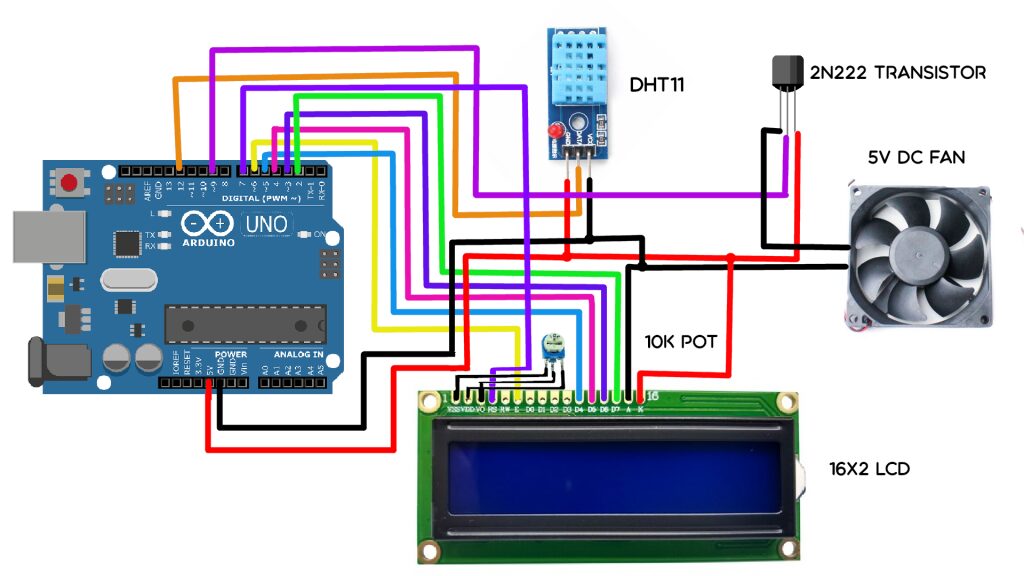
CIRCUIT DIAGRAM
Connection Description (Wiring Map)
Main Components :
Microcontroller: Arduino Uno / ESP32
Temperature Sensor: LM35 / DHT11 / DHT22
Relay Module (2-Channel): Controls Fan and AC
Fan & AC Load: Connected through relays
Power Supply: 5V regulated supply
6. LCD DISPLAY
Wiring Summary :
Component | Arduino Pin | Description |
Temperature Sensor (LM35) | A0 | Analog temperature input |
Relay 1 (Fan) | D8 | Turns the fan ON/OFF |
Relay 2 (AC) | D9 | Turns AC ON/OFF |
Relay VCC | 5V | Relay power supply |
Relay GND | GND | Common ground |
Load Connection:
Fan connected to Relay-1 COM & NO
AC connected to Relay-2 COM & NO
Working Principle :
The temperature sensor continuously measures room temperature.
Arduino reads the temperature value and compares it with predefined limits.
Based on temperature:
Below 28°C: All devices OFF
28°C – 34°C: Fan ON, AC OFF
Above 34°C: AC ON, Fan OFF
( Relays isolate high-voltage appliances from low-voltage electronics. )
Applications :
Smart homes
Offices and classrooms
Server rooms
Energy-saving automation systems
Testing the Hardware :
Temperature Sensor Test
Display temperature values in Serial Monitor
Verify accuracy using a thermometer
Relay Test
Manually trigger relays using Arduino code
Check if the fan and AC switch correctly
Load Test
Connect the fan and the AC to the relays
Observe correct switching at set temperature limits
Full System Test
Heat the sensor slightly
Verify automatic switching between the fan and the AC
Troubleshooting :
Issue | Possible Cause | Solution |
Fan or AC not switching | Wrong relay wiring | Check COM & NO connections |
Incorrect temperature reading | Sensor calibration issue | Recalibrate or replace the sensor |
Relay clicking but load OFF | Loose AC connection | Tighten wiring securely |
Arduino resets | Relay power issue | Use a separate relay power |
Both Fan & AC ON | Code logic error | Add a mutual exclusion condition |
( The Air Conditioner or Fan Switcher with Temperature Detection is an intelligent automation system designed to maintain a comfortable indoor environment by automatically switching between a fan and an air conditioner based on ambient temperature conditions. This system minimizes manual effort while optimizing energy usage.
The system uses a temperature sensor such as the DHT11 or similar sensors to continuously monitor the room temperature. The sensor sends real-time data to a microcontroller (like Arduino or ESP32), which processes the readings and compares them with predefined temperature thresholds.
When the temperature rises above a certain level, the system automatically turns on the air conditioner. Conversely, when the temperature is moderate or lower, it switches to a fan, ensuring efficient energy consumption. This working principle is based on temperature-based control system, where decisions are made dynamically based on environmental conditions.
Relay modules are used to control the switching of high-power appliances like fans and air conditioners safely. The system can also include an LCD or OLED display to show real-time temperature readings and system status.
Additional features may include IoT integration for remote monitoring and control via smartphone apps, customizable temperature settings, and scheduling options. This makes the system suitable for smart homes and energy-efficient building management.
This project is highly useful in homes, offices, and commercial spaces, helping maintain comfort while reducing electricity consumption and operational costs.
With further enhancements, the system can incorporate AI-based climate prediction, voice control, and integration with smart home ecosystems for a fully automated environment. )