
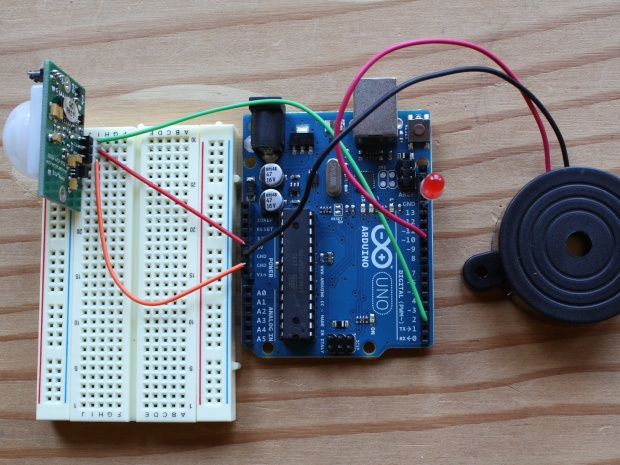
Key Features :
Night-only operation to minimize false alarms
Motion detection for accurate intruder identification
Audible and/or visual alarm activation
Cost-effective and simple home security solution
Security is a major concern for homes, offices, and institutions. Traditional alarm systems often operate continuously, which can lead to unnecessary alerts and false triggers during daytime activity.
As part of Advanced Smart Automation, the Night-Only Intruder Alarm System is designed to provide smarter and more efficient security by activating only under specific conditions. The system ensures that the alarm is triggered only when it is truly needed, improving reliability and reducing false alarms.
This system activates when :
- Ambient light falls below a predefined threshold (indicating nighttime)
- Motion is detected within a protected area
Once both conditions are met, the system triggers an alert using audible alarms, visual indicators, or both, depending on the design.
Connection Description (Wiring Map)
Main Components :
- Microcontroller: Arduino Uno / Nano
- PIR Motion Sensor: Detects movement
- Buzzer / Alarm: Intruder alert
- LED (optional): Visual indicator
- Power Supply: 5V regulated for Arduino and sensors
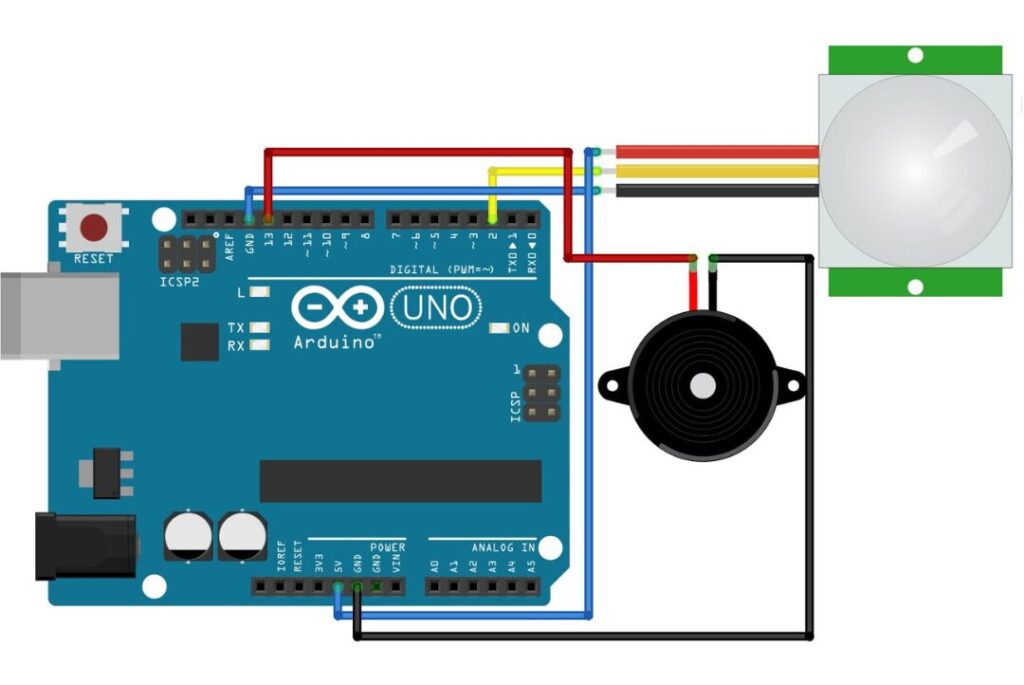
CIRCUIT DIAGRAMS
Wiring Summary :
Component | Arduino Pin | Description |
PIR Sensor OUT | D2 | Motion detection signal |
Buzzer | D3 | Audible alarm |
LED | D4 | Visual indicator (optional) |
Power | 5V / GND | Supply for Arduino and sensors |
Common Ground | GND | Shared ground |
Working Principle :
Night Detection:
LDR continuously measures ambient light.
If the light level falls below a set threshold, the system considers it nighttime.
Motion Detection:
The PIR sensor detects motion within its range.
Motion is checked only at night.
Alarm Activation:
If motion is detected at night, Arduino triggers the buzzer/LED alarm.
The alarm continues until reset or after a programmed duration.
Daytime Ignored:
During the day, the LDR disables motion detection to prevent false alarms.
Testing the Hardware :
LDR Sensor Test:
Measure analog values in light and darkness.
Adjust the threshold in the code for correct night detection.
PIR Sensor Test:
Walk in front of the sensor to verify motion detection.
Buzzer / LED Test:
Activate manually from Arduino to confirm working.
Full System Test:
Test in night conditions for motion detection and alarm activation.
Verify the system does not trigger during the daytime.
Applications :
Home and office security
Nighttime perimeter monitoring
School, college, or hostel security
Smart home security automation
Industrial night surveillance
Troubleshooting :
Problem | Possible Cause | Solution |
Alarm triggers in the day | LDR threshold too high | Adjust the analog threshold in the code |
Alarm not triggering at night | PIR sensor misalignment | Check the PIR sensor position and wiring |
Buzzer not working | Incorrect pin connection | Verify D3 connection and power |
System resets | Power drop | Use a regulated supply for the Arduino and buzzer |
False alarms | Sensor sensitivity | Adjust PIR sensitivity and placement |
( The Intruder Alarm (Night Only) is an automated security system designed to detect unauthorized entry specifically during nighttime conditions. It improves home and property security by activating only when it is dark, thereby reducing false alarms during daytime activities.
The system primarily uses a Light Dependent Resistor to detect ambient light levels. When the LDR senses low light intensity (indicating night time), the system becomes active. In addition, motion detection sensors such as PIR (Passive Infrared) or IR sensors are used to detect human movement within the monitored area.
A microcontroller such as Arduino or ESP32 continuously processes the input from both the light and motion sensors. When both conditions are satisfied—darkness and detected movement—the system triggers an alert mechanism such as a buzzer, siren, or LED indicator. Advanced versions can also send notifications through GSM or IoT modules to alert the homeowner remotely.
The system is based on the concept of smart conditional monitoring, ensuring that the alarm only activates under valid intrusion scenarios. This helps in improving accuracy and preventing unnecessary disturbances.
This project is highly useful for home security systems, small offices, warehouses, and restricted areas. It provides a low-cost and efficient solution for nighttime surveillance and intrusion detection.
With further enhancements, the system can be upgraded with camera modules for image capture, mobile app integration for real-time alerts, and AI-based motion analysis for improved accuracy and intelligent threat detection. )