
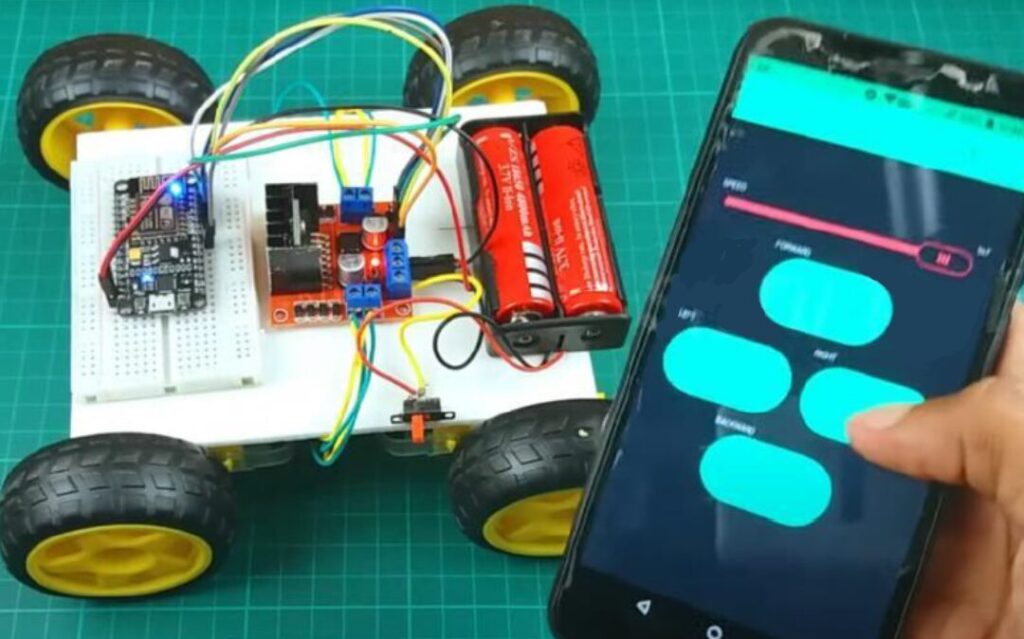
Remote robot control plays a crucial role in modern automation, surveillance systems, and industrial applications. While traditional Bluetooth-based systems are limited by short range, Wi-Fi-based control offers a powerful alternative by enabling long-distance operation through the internet.
As part of Advanced Motion Control Robotic Projects, the Wi-Fi Controlled Robot allows users to operate and monitor a robotic system from anywhere using a web interface or mobile application. Commands are sent over a Wi-Fi network and processed in real time by a microcontroller or embedded system.
These commands are then used to control motor drivers, enabling precise motion such as forward, backward, left, right, and stop operations with smooth responsiveness.
Key Features :
- Control robot using smartphone over Wi-Fi
- User-friendly Blynk mobile interface
- Real-time response
- Suitable for IoT-based automation projects
Connection Description (Wiring Map)
Main Components :
- Microcontroller: ESP8266 (NodeMCU) / ESP32
- Motor Driver: L298N / L293D
- DC Motors & Chassis
- Blynk Mobile App
- Power Supply: Battery pack (7.4V / 12V)
Applications :
- Remote surveillance robots
- IoT-based robotic control
- Industrial automation prototypes
Educational IoT projects
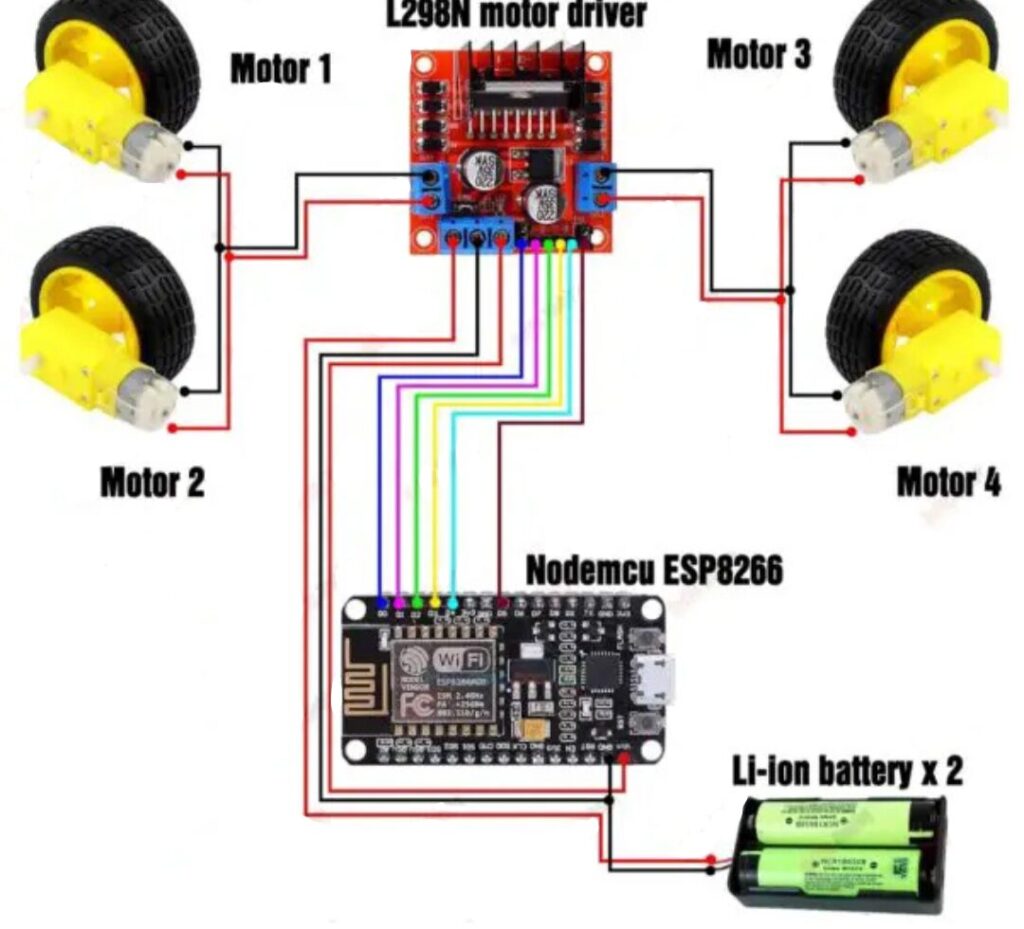
CIRCUIT DIAGRAM
Wiring Summary (Using NodeMCU ESP8266) :
Component | NodeMCU Pin | Description |
Motor Driver IN1 | D1 | Left motor control |
Motor Driver IN2 | D2 | Left motor control |
Motor Driver IN3 | D3 | Right motor control |
Motor Driver IN4 | D4 | Right motor control |
Motor Driver ENA/ENB | Jumper / PWM | Speed control |
NodeMCU GND | GND | Common ground |
NodeMCU Vin | Battery + | Power input |
Motor Connection:
- Left motor → OUT1 & OUT2
- Right motor → OUT3 & OUT4
Working Principle :
- NodeMCU/ESP32 connects to Wi-Fi network.
- Blynk app sends control signals when buttons are pressed.
- Microcontroller receives commands via Blynk cloud.
- Commands activate motor driver pins.
- Robot moves forward, backward, left, right, or stops
Testing the Hardware:
- Wi-Fi Test
- Verify Wi-Fi connection status in Serial Monitor.
- Blynk App Test
- Press virtual buttons and check signal response.
- Motor Test
- Run motors individually.
- Full System Test
- Control robot using Blynk app.
Troubleshooting :
Issue | Possible Cause | Solution |
Robot not responding | Wrong Blynk token | Check authentication token |
Wi-Fi not connecting | Wrong SSID/password | Verify Wi-Fi credentials |
Motors not moving | Power supply issue | Use separate motor battery |
Delay in control | Weak internet | Improve network signal |
Board resets | Voltage drop | Use regulated supply |
( The Wi-Fi Controlled Robot with Blynk App is a smart robotic system that can be remotely controlled over the internet using a smartphone. It uses wireless communication to enable real-time navigation and control, allowing users to operate the robot from anywhere within the Wi-Fi network or internet range.
The system is integrated with the Blynk application, which provides a user-friendly interface with buttons, sliders, and virtual controls. These controls send commands through the cloud or local Wi-Fi network to a microcontroller such as ESP8266 or ESP32, which processes the instructions and controls the robot’s movement accordingly.
The robot typically consists of a motor driver module, DC motors, and a Wi-Fi-enabled microcontroller. When a command is received from the Blynk app, the microcontroller interprets the signal and drives the motors to move the robot forward, backward, left, or right. This allows smooth and responsive real-time control.
This project demonstrates the integration of Internet of Things, wireless communication, and robotics, making it an excellent example of modern smart automation systems. It highlights how devices can be controlled remotely using cloud-based platforms and mobile applications.
Wi-Fi controlled robots are widely used in industrial automation, surveillance systems, military applications, and educational robotics. They are also useful for exploring IoT concepts such as remote monitoring, device-to-cloud communication, and smart control systems.
With further enhancements, the system can include camera streaming, voice control, obstacle avoidance, and AI-based navigation for more advanced autonomous behavior. )