
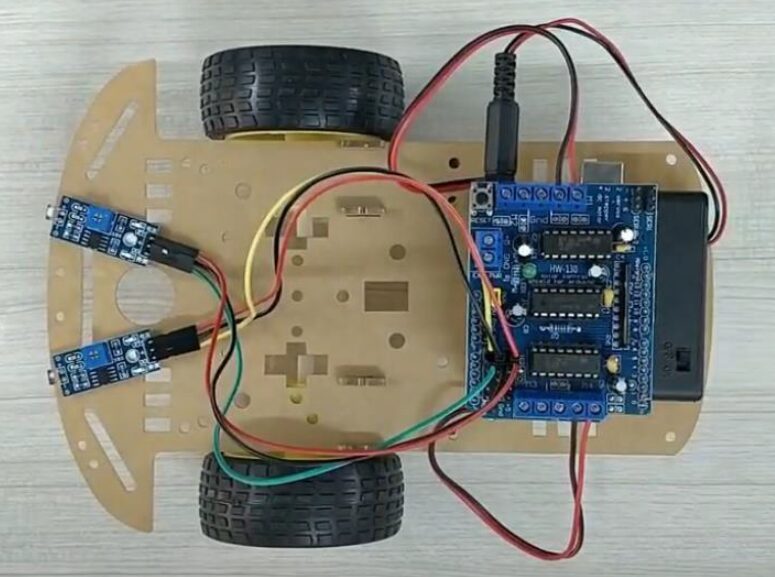
Phototropism is a natural biological phenomenon where organisms move or grow in response to light. Inspired by this concept, the High-Precision Light Following Robot (Phototropic Bot) is designed to automatically move toward a light source without any human intervention.
This robot uses Light Dependent Resistors (LDRs) to detect the intensity and direction of light from different angles. Based on the sensor readings, a microcontroller processes the data and determines the direction of maximum light intensity.
The motor driver then controls the robot’s movement accordingly, allowing it to adjust its path in real time and continuously follow the light source with high accuracy.
Key Features :
- Fully autonomous operation
- Detects and follows light sources
- Simple and cost-effective design
- Ideal for beginners in robotics
Connection Description (Wiring Map)
Main Components :
- Microcontroller: Arduino Uno / Nano
- Light Sensors: LDRs with voltage divider circuits
- Motor Driver: L298N / L293D
- DC Motors: For movement
- Robot Chassis & Wheels
- Power Supply: Battery (9V / 12V)
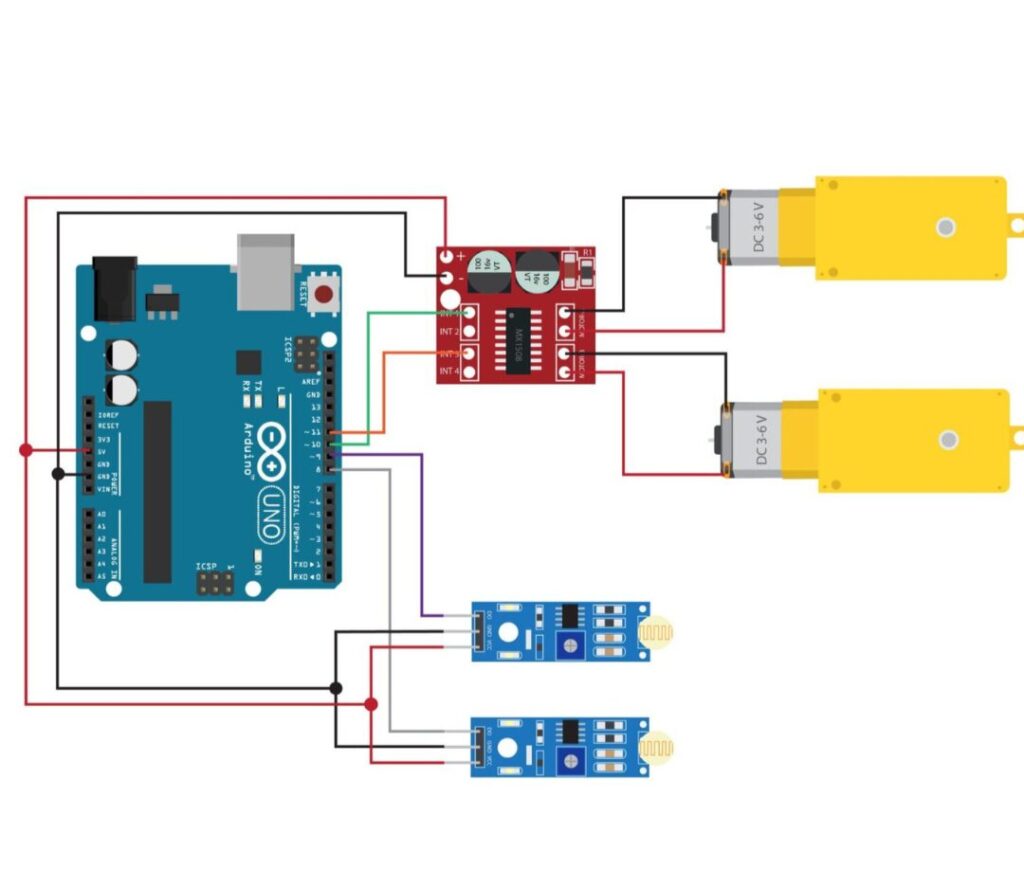
CIRCUIT DIAGRAM
Wiring Summary :
Component | Arduino Pin | Description |
Left LDR | A0 | Detects light on the left side |
Right LDR | A1 | Detects light on the right side |
Motor Driver IN1 | D4 | Left motor control |
Motor Driver IN2 | D5 | Left motor control |
Motor Driver IN3 | D6 | Right motor control |
Motor Driver IN4 | D7 | Right motor control |
Motor Driver ENA/ENB | Jumper / PWM pins | Motor speed control |
Power Supply | Vin / GND | System power |
Common Ground | GND | Shared ground |
LDR Circuit :
- Each LDR forms a voltage divider with a resistor
- Output voltage varies with light intensity
Working Principle :
- LDRs continuously sense light intensity.
- Arduino compares values from left and right sensors.
- Movement logic:
- Both sensors equal: Robot moves forward
- Left LDR brighter: Robot turns left
- Right LDR brighter: Robot turns right
- Low light on both: Robot stops
- Both sensors equal: Robot moves forward
- Motor driver activates motors accordingly
Testing the Hardware :
LDR Sensor Test
View analog readings in Serial Monitor
Shine a torch to observe value changes
Motor Test
Test motors individually using motor driver
Directional Test
Shine light from different directions
Verify correct turning behavior
Full System Test
Place robot in dark area
Move light source and observe robot following it
Troubleshooting :
Problem | Possible Cause | Solution |
Robot not moving | Battery drained | Recharge or replace battery |
Robot moves in wrong direction | LDR wiring reversed | Swap LDR connections |
Erratic movement | Ambient light interference | Shield LDRs or adjust threshold |
Motors not rotating | Motor driver fault | Check driver IC and connections |
Robot keeps rotating | Sensor sensitivity mismatch | Calibrate LDR resistor values |
( A Light Following Robot, also known as a Phototropic Bot, is an autonomous robotic system designed to detect and move toward a light source. The robot operates based on the principle of phototropism, where it senses variations in light intensity and adjusts its movement toward the brightest direction.
The system typically uses light-dependent resistors (LDRs) or photodiode sensors to measure light intensity from different directions. These sensor readings are continuously monitored by a microcontroller such as Arduino or ESP32, which compares the values and determines the direction of the strongest light source.
Based on the sensor input, the microcontroller controls motor drivers to adjust the movement of DC motors, enabling the robot to move toward the light. For example, if the left sensor detects higher light intensity, the robot turns left, and if the right sensor detects more light, it turns right.
This concept is based on phototropism, which is commonly observed in plants that grow toward sunlight. The robot mimics this natural behavior using electronic sensors and control systems.
A Light Following Robot is widely used in educational robotics to demonstrate basic concepts of sensor integration, feedback systems, and autonomous navigation. It also serves as a foundation for more advanced robotics applications such as solar tracking systems, smart energy optimization devices, and AI-based navigation robots.
With further improvements, the system can be enhanced with obstacle detection, speed control, and multi-sensor fusion to improve accuracy and performance in complex environments. )