
Water pollution caused by floating waste is a serious environmental issue affecting rivers, lakes, and oceans worldwide. Manual cleaning methods are often labor-intensive, unsafe, and inefficient, especially for large water bodies.
Among Efficient Service Robot Projects, the River Cleaning Robot offers a practical and automated solution to this problem. The system is designed to continuously collect and remove floating waste from water surfaces without requiring human intervention.
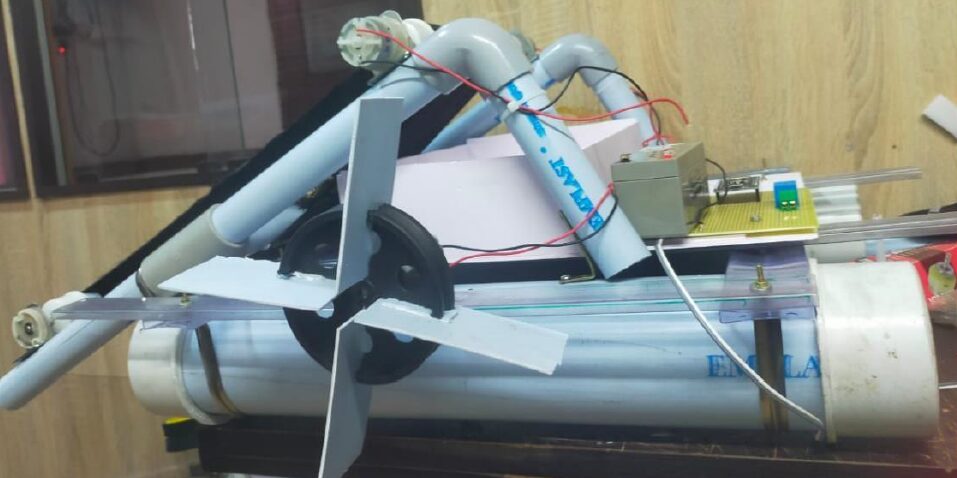
This robot integrates mechanical design, sensors, and motor control to navigate water bodies and efficiently gather debris. A conveyor or collection mechanism is typically used to trap floating waste and store it in a container for safe disposal.
Key Features :
- Automated collection of floating waste
- Reduces human effort and health risks
- Eco-friendly solution
- Suitable for rivers, canals, and lakes
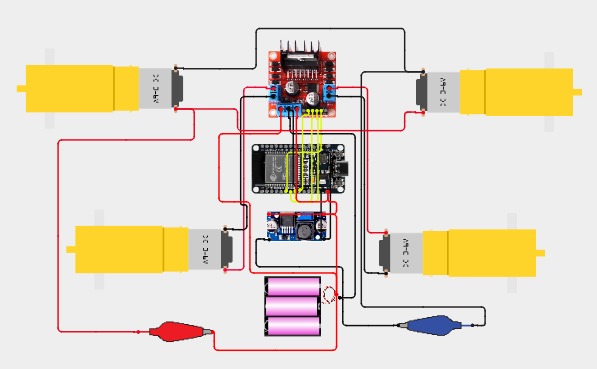
CIRCUIT DIAGRAM
Connection Description (Wiring Map)
Main Components :
- Microcontroller: Arduino Uno / Mega
- DC Motors: Propulsion and conveyor motors
- Motor Driver: L298N / L293D
- IR / Ultrasonic Sensor: Waste detection
- Conveyor Belt / Scooping Mechanism
- Floating Platform (Buoyancy system)
- Power Supply: Rechargeable battery pack
Wiring Summary :
Component | Arduino Pin | Description |
Motor Driver IN1 | D4 | Left propulsion motor |
Motor Driver IN2 | D5 | Left propulsion motor |
Motor Driver IN3 | D6 | Right propulsion motor |
Motor Driver IN4 | D7 | Right propulsion motor |
Conveyor Motor | D9 | Waste collection |
IR / Ultrasonic Sensor | D2 | Waste detection |
Motor Driver GND | GND | Common ground |
Power Supply | Vin | System power |
Important: Use waterproof connectors and ensure common ground between all modules.
Working Principle :
The robot floats on the water surface using buoyant material.
Propulsion motors move the robot forward.
An IR or ultrasonic sensor detects floating waste.
Conveyor motor activates to collect waste.
Waste is lifted and deposited into a storage container.
Robot continues cleaning until container is full.
Testing the Hardware :
Buoyancy Test
Check float stability in water.
Motor Test
Test propulsion and conveyor motors separately.
Sensor Test
Detect waste objects accurately.
Collection Test
Collect plastic waste from water surface.
Full System Test
Run robot continuously and monitor performance.
Applications :
River and canal cleaning
Lake and pond maintenance
Harbor and coastal cleanup
Environmental research projects
Smart city initiatives
Troubleshooting :
Problem | Possible Cause | Solution |
Robot sinks | Insufficient buoyancy | Add more float material |
Waste not collected | Conveyor misalignment | Adjust conveyor angle |
Motors not running | Power supply issue | Recharge battery |
Sensor false detection | Water reflection | Adjust sensor sensitivity |
System stops | Overload | Reduce waste intake |
( The River Cleaning Robot is an automated floating robotic system designed to collect and remove solid waste such as plastic bottles, bags, and floating debris from rivers, lakes, and other water bodies. The system is developed to address the growing issue of water pollution caused by unmanaged waste disposal and to support environmental conservation efforts.
The robot typically operates on a floating platform equipped with a propulsion system and a waste collection mechanism such as a conveyor belt or scooping arm. As it moves across the water surface, it collects floating waste and stores it in an onboard container for later disposal or recycling.
The system is controlled using a microcontroller or microcomputer such as Arduino or ESP32, and can be enhanced with sensors like ultrasonic sensors for obstacle detection and water level monitoring. Advanced versions may also use camera-based detection systems with OpenCV to identify waste concentration areas and optimize cleaning paths.
Solar panels can be integrated to make the robot energy-efficient and suitable for long-term outdoor operation. Wireless communication modules can also be added for remote monitoring and control, enabling real-time tracking of the robot’s movement and collected waste data.
This project is highly useful for maintaining clean water bodies, protecting aquatic life from plastic ingestion and entanglement, and improving overall ecosystem health. It also supports smart environmental management initiatives and can be deployed in urban waterways, lakes, canals, and rivers.
With further improvements, the system can be scaled into autonomous fleets of cleaning robots working collaboratively to cover larger water surfaces efficiently. )