
Solar panels generate electricity based on the amount of sunlight falling on them. However, fixed solar panels have limited efficiency because the position of the sun changes continuously throughout the day and across seasons.
In the domain of Eco-Friendly Solar Power Robotic Projects, a Dual Axis Solar Tracker provides an intelligent solution to this limitation. This system automatically adjusts the orientation of the solar panel along both horizontal and vertical axes to continuously face the sun.
By tracking the sun’s movement in real time, the system ensures maximum exposure to sunlight, significantly improving energy output compared to stationary panels.
Key Features :
Uses Light Dependent Resistors (LDRs) to detect sunlight intensity.
Moves the solar panel in horizontal and vertical directions using motors.
Can increase solar panel efficiency by up to 25–30%.
Fully automated with microcontroller-based control.
This project demonstrates a practical application of renewable energy, robotics, and automation for sustainable energy harvesting.
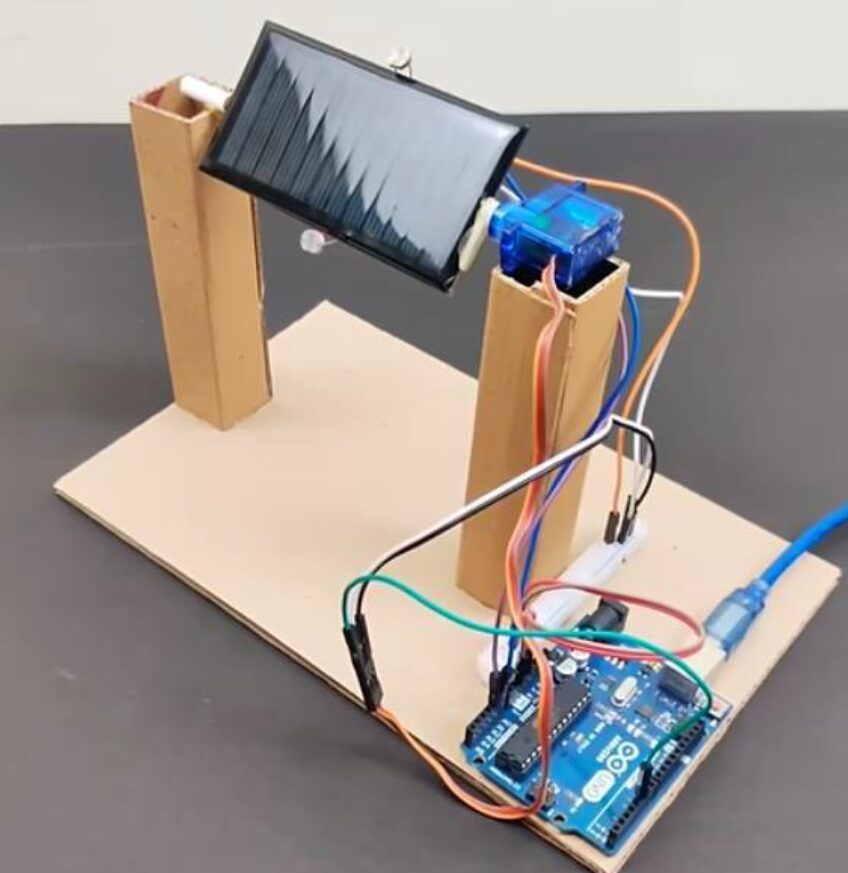
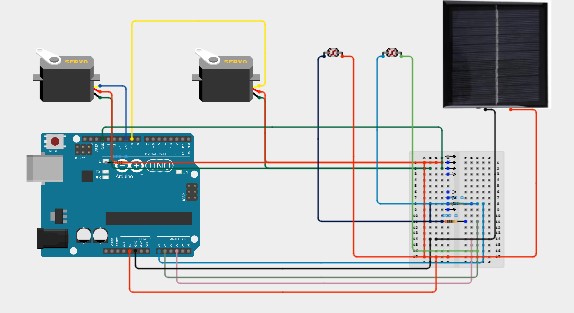
CIRCUIT DIAGRAM
Connection Description (Wiring Map)
Main Components :
- Microcontroller: Arduino Uno / ESP32
- Light Sensors (LDRs): Detect the direction of maximum sunlight
- Motors: DC motors or servo motors for panel rotation (horizontal & vertical)
- Motor Driver (L298N / ULN2003): Controls the movement of motors
- Solar Panel Mount: Platform for solar panel
- Power Supply: Batteries or solar-powered DC supply for motors and controller
Wiring Summary :
Component | Arduino Pin | Connection Notes |
LDR Sensors | A0, A1, A2, A3 | Four LDRs for north, south, east, and west directions |
DC/Servo Motors | Motor Driver IN1-IN4 | Controls panel rotation horizontally and vertically |
Motor Driver Power | 12V DC | Powers motors through motor driver |
Arduino Power | 5V regulated DC | Powers Arduino and sensors |
Visual Wiring Map (Simplified) :
- LDR sensors mounted in four directions, connected to analog input pins on Arduino
- Arduino reads LDR values to determine the brightest direction
- Motor driver connected to Arduino digital pins, controls motor movement to align the panel
- Power supply provides sufficient current to the motors and Arduino
Testing the Hardware :
- LDR Sensor Test: Verify analog readings from LDRs under sunlight to detect light intensity correctly.
- Motor Test: Test motors via the motor driver for correct movement in horizontal and vertical axes.
- Integration Test: Place the solar tracker under sunlight; it should rotate the panel toward the direction of maximum light automatically.
- Continuous Operation Test: Observe the system for several hours to ensure consistent tracking performance.
APPLICATIONS :
- Solar Power Plants – Increases energy output by automatically following the sun’s movement.
Residential Solar Systems – Improves efficiency of home rooftop solar panels.
Street Lighting Systems – Used in solar street lights for maximum daytime charging.
Agricultural Irrigation Systems – Powers solar water pumps with higher energy efficiency.
Remote & Rural Electrification – Provides better power generation in off-grid areas.
Industrial Power Backup – Enhances performance of solar-based backup systems.
Research & Educational Projects – Used in engineering and robotics projects for renewable energy studies.
Troubleshooting :
Problem | Possible Cause | Solution |
Motors not moving | Motor driver or power supply issue | Check wiring, voltage, and motor driver connections |
LDR sensors not detecting sunlight | Misaligned sensors or low sensitivity | Adjust sensor placement or use better LDRs |
Panel moves erratically | Incorrect sensor reading or code logic | Calibrate LDR threshold and adjust code |
Arduino resets under load | Insufficient power supply | Provide separate regulated power for motors and Arduino |
The system stops during a cloudy day | Low sunlight intensity | Implement threshold logic to handle low light |
( A Solar Tracker is a system that automatically adjusts the orientation of solar panels to face the sun throughout the day. By maximizing sunlight exposure, solar trackers significantly improve the efficiency and energy output of solar panels compared to fixed installations. This project uses sensors and motors to detect the sun’s position and adjusts the panel accordingly, providing an intelligent and automated solution for renewable energy systems. )