
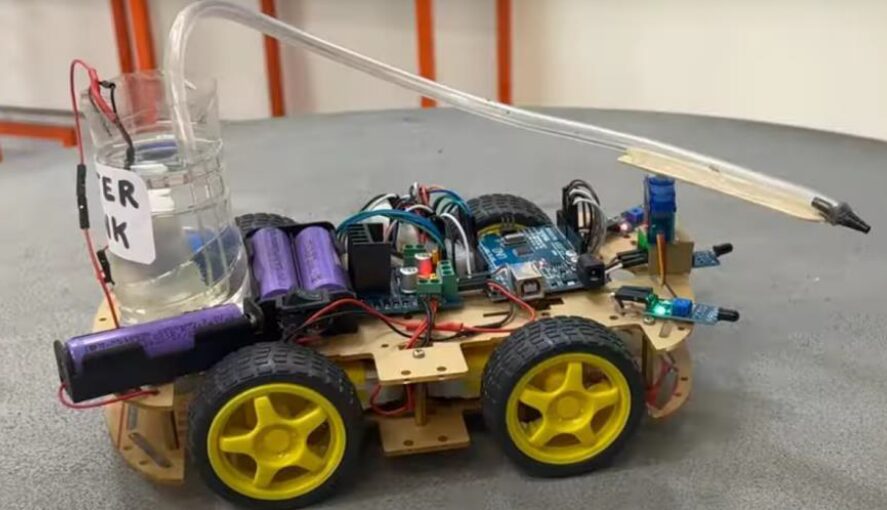
Fire accidents are a major threat in industries, warehouses, and even residential areas. Human intervention in a fire-prone environment is risky and often delayed. The Fire Extinguisher Robot provides a solution by autonomously locating the fire and deploying extinguishing agents.
Key features of this robot:
- Fire Detection: Detects flame or high-temperature areas using flame sensors or infrared sensors.
- Mobility: Moves autonomously or via remote control to reach the fire source.
- Extinguishing Mechanism: Activates a mini water pump or a fire extinguisher spray to put out the fire.
- Obstacle Avoidance: Avoids obstacles using ultrasonic sensors or IR obstacle sensors.
This project combines safety, robotics, and automation to create a practical solution for fire emergencies.
Connection Description (Wiring Map)
The robot’s hardware typically consists of:
- Microcontroller: Arduino Uno (or similar) – acts as the brain of the robot.
- Motors & Motor Driver: DC motors with L298N motor driver for movement control.
- Flame Sensor: Detects fire by sensing infrared light emitted by flames.
- Servo Motor: Controls the direction of the fire extinguisher spray.
- Water Pump / Mini Fire Extinguisher: For extinguishing fire.
- Ultrasonic Sensor (optional): For obstacle detection and navigation.
Power Supply: Battery pack for the robot and motors.
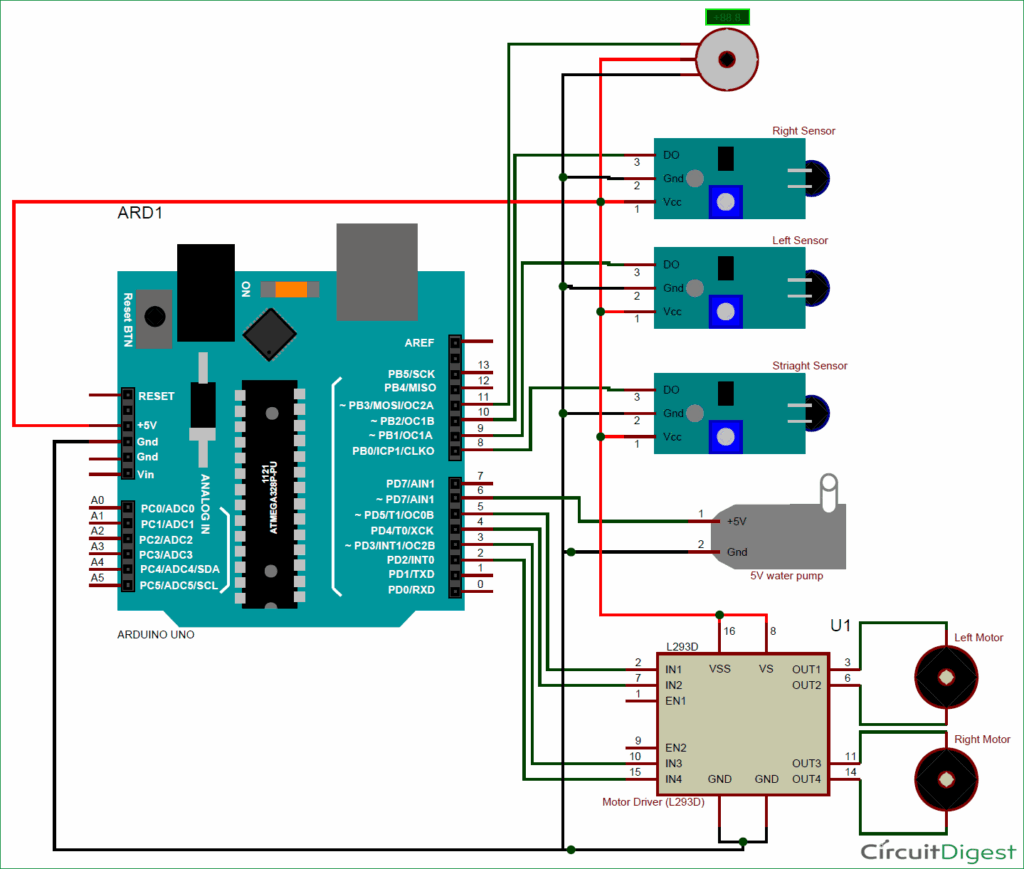
CIRCUIT DIAGRAM
Wiring Summary:
Component | Arduino Pin | Connection Notes |
Flame Sensor | A0 | Analog output connected to Arduino |
Ultrasonic Sensor | D7 (Trig), D8 (Echo) | For obstacle detection |
DC Motors | L298N Motor Driver IN1-IN4 | Motor driver connected to Arduino pins |
Servo Motor | D9 | Controls extinguisher angle |
Water Pump | Relay Module/D10 | Relay switches the pump ON/OFF |
Battery | Vin & GND | Powers Arduino and motors |
Visual Wiring Map: (You can draw or imagine)
- Arduino connected to motor driver
- Motor driver connected to left/right DC motors
- Flame sensor connected to analog pin
- Servo motor connected to digital PWM pin
Relay module connected to digital pin controlling the water pump
Testing the Hardware
Testing each module individually ensures smooth integration:
- Motor Test: Connect the DC motors to the L298N driver and test forward, backward, left, and right movement.
- Flame Sensor Test: Bring a flame near the sensor and check if the Arduino reads high analog values.
- Servo Motor Test: Move the servo to ensure it can direct the extinguishing mechanism.
- Water Pump Test: Activate the relay to turn on the water pump; verify flow is adequate.
- Obstacle Sensor Test: Verify that ultrasonic or IR sensors detect nearby obstacles.
Integration Test: Combine all modules, move the robot, detect fire, and activate the extinguishing mechanism.
Application
- Homes & apartments (kitchen/electrical fires)
- Offices & malls (early fire suppression, night patrol)
- Factories & workshops (welding/CNC/paint areas)
- Warehouses (storage rack fires)
- Electrical rooms/substations/DG rooms (panel & cable fires)
- Hospitals & labs (quick response in risky zones)
- Restaurants/commercial kitchens (grease-fire systems)
- EV charging/parking areas (initial fire control)
- Fire departments (high-heat/smoke rescue support)
Troubleshooting
Some common issues and solutions:
Problem | Possible Cause | Solution |
Robot not moving | Motor driver not powered or wired incorrectly | Check power supply and motor connections |
Flame sensor not detecting fire | Sensor misaligned or ambient light interference | Adjust sensor angle, shield from ambient light |
Servo not moving | Incorrect PWM signal | Check Arduino code and wiring |
Water pump not turning on | Relay module not triggered or low battery | Verify relay connections and battery |
Obstacle avoidance fails | Ultrasonic sensor misaligned | Reposition sensor for better coverage |
( A Fire Extinguisher Robot is an autonomous or semi-autonomous robotic system designed to detect and extinguish fires without putting human lives at risk. Using sensors to detect fire (like flames or heat), and actuators to move and operate the fire extinguishing mechanism, this robot can navigate through obstacles to reach the fire source. This project integrates robotics, electronics, and automation concepts to enhance safety in hazardous situations. )