
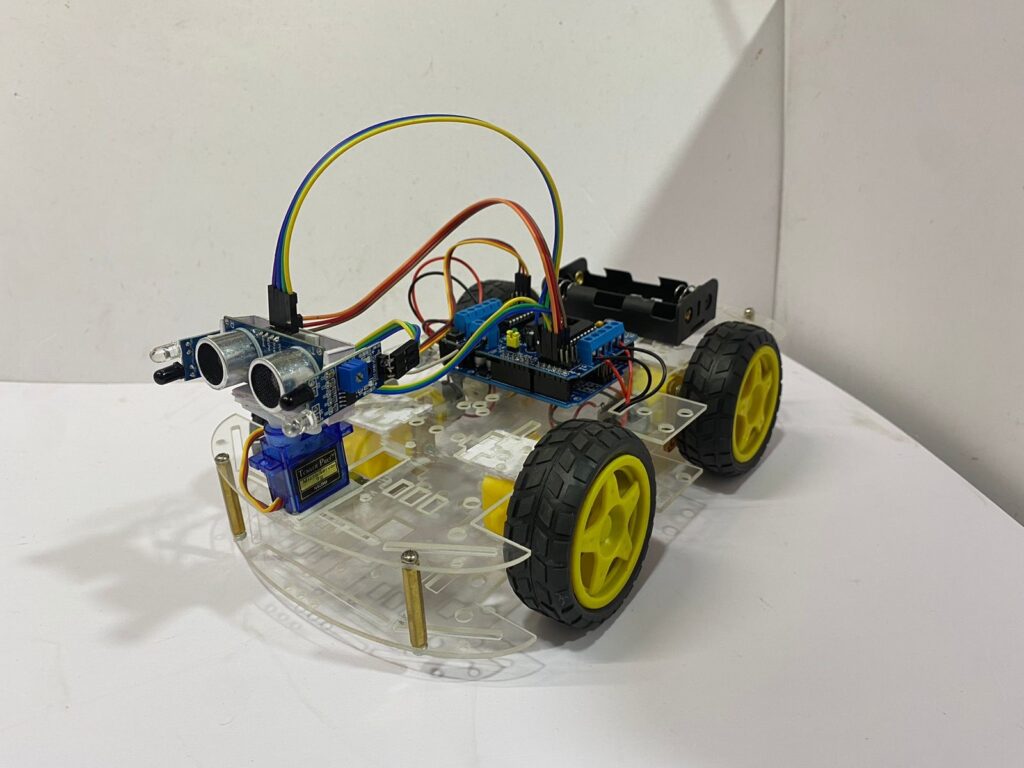
The DIY Robotic Kit – Arduino Human Following Robot is an exciting and educational project that showcases the power of robotics and automation. This autonomous mobile system is designed to intelligently detect and follow a human while maintaining a fixed distance, making it an excellent introduction to real-world robotics concepts.
The robot integrates ultrasonic and infrared (IR) sensors to accurately measure the presence, distance, and direction of a moving person. Based on the sensor readings, the robot automatically moves forward, backward, or turns to follow the user, ensuring smooth and collision-free navigation.
At the heart of this DIY Robotic Kit is the Arduino microcontroller, which processes the sensor data and controls the motors for movement. The addition of servo-based scanning enhances the robot’s ability to locate and track the target dynamically, giving it motion behavior similar to smart assistant robots or automated shopping carts used in advanced robotics applications.
This DIY Robotic Kit not only helps learners understand concepts like sensor integration, servo control, and autonomous navigation, but also provides hands-on experience in building and programming intelligent robotic systems — making it perfect for students, hobbyists, and STEM enthusiasts eager to explore the world of robotics.
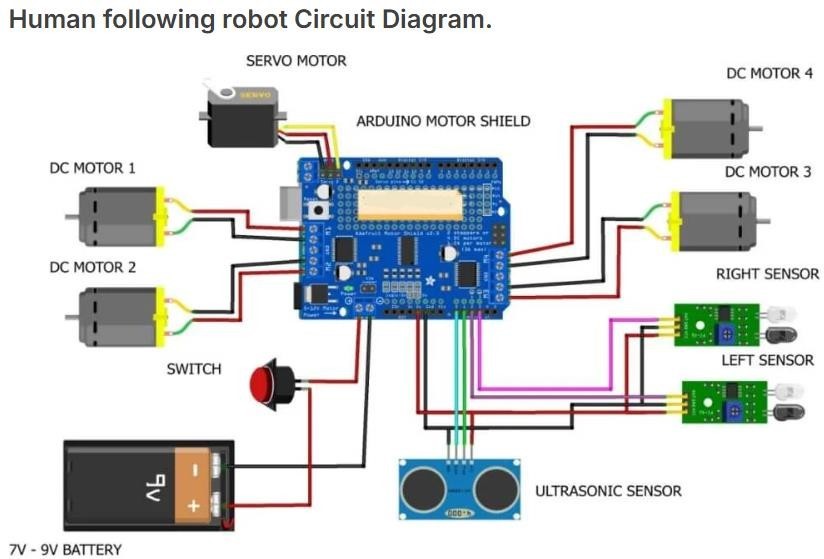
Connection description :
1. Ultrasonic sensor :
HC-SR04 Pin | Arduino Pin | Description |
VCC | 5V | Power |
GND | GND | Ground |
TRIG | A1 | Trigger pin (sends signal) |
ECHO | A0 | Echo pin (receives reflection) |
2. IR Sensors :
IR Sensor | Arduino Pin | Description |
Right IR Sensor OUT | A2 | Digital output from right sensor |
Left IR Sensor OUT | A3 | Digital output from left sensor |
VCC (both) | 5V | Power supply |
GND (both) | GND | Common ground |
3. Servo motor :
Servo Pin | Arduino Pin | Description |
Signal (Yellow/Orange) | Pin 10 | PWM control pin |
VCC (Red) | 5V | Power |
GND (Brown/Black) | GND | Ground |
4. Motors via Adafruit motor shield :
Motor | Motor Shield Port | Function |
Front Left Motor | M1 | Left front wheel |
Front Right Motor | M2 | Right front wheel |
Back Left Motor | M3 | Left rear wheel |
Back Right Motor | M4 | Right rear wheel |
Test the Hardware :
Check power connections — verify that both Arduino and motors are receiving power.
Upload the Arduino code for human following operation.
Test the ultrasonic sensor:
Move an object (or person) in front of it.
Verify that the sensor detects distance within 10–30 cm.
Test servo scanning:
The servo should rotate the ultrasonic sensor left and right automatically.
Test IR sensors:
When a person is to the left → left IR sensor triggers.
When to the right → right IR sensor triggers.
Run full system:
Robot moves forward when a person is within range.
Turns to re-center when a person moves sideways.
Stops if the person gets too close (<10 cm).
Troubleshooting :
Problem | Possible Cause | Solution |
Robot doesn’t move | Motor shield not powered or code issue | Check motor power (6–12V) and upload code again |
Servo not rotating | Incorrect pin connection or power drop | Ensure servo connected to D10 and powered from 5V |
Ultrasonic sensor not detecting | Echo/Trig pins swapped or loose wires | Verify connections and ensure common ground |
IR sensors not responding | Wrong analog pin or damaged sensor | Recheck A0/A1 connections and test individually |
Robot moves in wrong direction | Motors connected in reverse | Swap motor wires on AFMotor shield outputs |
Robot vibrates or stops suddenly | Low battery voltage | Use a fresh or higher-capacity battery pack |
( The Arduino-Based Human Following Robot is an autonomous system that detects and follows a human while maintaining a safe distance using ultrasonic and infrared sensors. The robot uses an Arduino Uno as the controller, an HC-SR04 ultrasonic sensor for distance measurement, and two IR sensors to determine left and right direction. A servo motor rotates the ultrasonic sensor to scan for human presence, and the Adafruit Motor Shield drives four DC motors for movement.
When a person is detected within 10–30 cm, the robot moves forward to follow. If the person moves sideways, the robot turns accordingly, and it stops if the distance becomes too close. This project showcases practical applications of sensor integration, servo control, and autonomous navigation, suitable for building personal assistant robots, smart carts, or automated surveillance systems. )